Showing posts with label The Big Swim. Show all posts

Friday, January 30, 2009

Banning High-Tech Suits and Heel Wafting in Australia

Nearly 3,000 swimmers will participate in the 26th annual Cole Classic to be held this Sunday in Sydney, Australia.


The 1K and 2K swims are always popular and always competitive, but with the growth of the sport, it was reported on Australian radio that some open water enthusiasts individuals want "heel wafting" to be banned.


Additionally, with high-tech swim suits beginning to be banned in various Australia swims from the Big Swim to the Byron Bay Ocean Swim Classic, it is certainly interesting times in the sport.

Thursday, January 22, 2009

The Evolution of the Sport

In a recent article in the Sydney Morning Herald, Steve Meacham writes about racing etiquette and high-tech swim suits.

His article touched on the debate among swimmers in the build-up to the Big Swim in Sydney, Australia.

The open water swimming community is debating if competitors should be allowed to swim in the latest high-tech suits. But, the Big Swim enthusiasts delve even deeper into more fundamental issues: Is it acceptable for faster swimmers to swim over the top of slower competitors? Should race organizers police antisocial behavior especially around the turn buoys?

Because our sport is growing FAST all over the world attracting people of all ages and abilities to events in every kind of water, we will inevitably run up against various issues. Fortunately, the sport, its rules, its equipment, its training methodologies, its timing technology, its national and international infrastructure and its athletes are continuously evolving … for the better.
To use an open water analogy, we may be swimming in a bit of rough water now, but the currents are strongly in our favor.

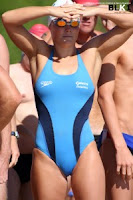
This year, the Big Swim organizers leveled the playing field by forcing swimmers to wear conventional swim suits. The organizers decided that the swim suits must contain no neoprene or any other 'high-tech' material or any material with any flotation support. The male suits cannot cover any part of their body above the waist and female suits cannot cover their arms or legs.


This decision eliminated the use of blueseventy, Speedo, TYR and other high-tech swim suits to the satisfaction of purists.

For those who did make the investment in a high-tech suit, they may be disappointed. From our perspective, a better alternative is to offer a 'high-tech' race and a 'traditional' race for the competitors.

We say: double the fun, don't half the alternatives.


Unlike pool swimming which is limited to 8 people racing in rectangular chlorinated pools with lines, lanes and controlled water temperature, open water swimming venues and competitions are only limited by the creativity of race directors and the desires of swimmers.

It is our belief – backed by observations and economic reality – that open water swimmers – both newcomers and veterans – will continue to demand and purchase a variety of high-tech suits, wetsuits and all kinds of new products that have yet to be designed or manufactured.

While many people enjoy open water swimming primarily for the challenge of finishing and the camaraderie of the sport, many others like to push themselves to see how fast they can swim – whether it is a race against others or as a comparison to their previous performance.

While we understand and greatly appreciate swimming in nothing but a traditional swim suit and goggles, we also understand why many people enjoy the speed and performance enhancement they feel in a high-tech suit.

While we understand the sense of fairness and establishing a level playing field, we also wonder think that if high-tech suits are allowable in the pool, then they should also be allowed in open water events.

While we understand the high-tech suits are costly and not everyone can afford them, we also think that a more restrictive policy is not optimal in a sport that is growing and attracting new enthusiasts every day.

While we understand and appreciate the challenge of swimming in cold water, and learning how to swim properly without having the advantages of high-tech suits, we also greatly appreciate the financial support the new high-tech suit manufacturers have provided to the sport.

Isn't it better to keep both sides of the debate happy? From Hong Kong to Helsinki, many races have a 'wetsuit' and a 'non-wetsuit' division. Give more awards – not fewer – and keep more swimmers happy.


Perhaps another alternative is to establish a new award category With contemporary timing systems, it is easy to compare the times of the 'high-tech' swimmers versus the 'traditional' swimmers. To create a little buzz, race directors can handicap the competitors.

That is, if the average time of high-tech swimmers from the previous year is 90 seconds faster than the times of traditional swimmers, then the high-tech swimmers can be handicapped by 90 seconds. See who 'wins' the race and give that swimmer a special award.

In any case, the Big Swim has made its decision. Some people are happy; some are not; and others are indifferent. Swimmers can now swim mano-a-mano under traditional rules competing for the same prizes. We applaud the decision-makers.

On the other hand, we believe open water swimming is extremely enjoyable for a rapidly increasing number of individuals. Not only are there race directors who see the value in allowing high-tech suits, but there are also many newcomers and veterans who enjoy racing in a high-tech suit.

In summary, we believe the demand for fast suits and new technology will continue at an unrelenting pace while purists can still enjoy the sport in the manner they see fit.

The evolution of the sport is good for all.

Wednesday, November 5, 2008

Open Water Film Tour

The Open Water Tour, produced by the Santa Barbara Ocean Film Festival, will be coming to Washington D.C. on November 19th. For open water swimmers in the mid-Atlantic area, this will be a very enjoyable night of award-winning ocean films from the Santa Barbara Ocean Film Festival, now in its fifth year.

Films on giant mantas and great white sharks to whales will be highlighted. The founder of the Santa Barbara Ocean Film Festival, Michael Hanrahan, also produced a film on the THE BIG SWIM, a 26-mile relay challenge across the Santa Barbara Channel off the California coast.

"Yet another gem from the Ocean Channel...what began as a wonderful, local festival celebrating the talented ocean filmmakers surrounding Santa Barbara. Santa Barbara has grown into a truly international event, showcasing and premiering ocean-related and conservation films that (thankfully) give new meaning to the term 'shock and awe'. It is a great event. You want to go," says Mike deGruy, award-winning producer and Discovery Channel's SHARK WEEK host.

Photo from the Ocean Channel of the THE BIG SWIM.

Thursday, October 2, 2008

The Big Swim Donation

THE 55 BIG SWIM relay swimmers donated US$27,000 to the National Marine Sanctuary Foundation as a result of their recent 26-mile crossing of the Santa Barbara Channel.

After enjoying the channel crossing, the team members donated an incredible average of US$490 per swimmer to the National Marine Sanctuary Foundation. Daniel Belding kicked off the efforts by raising $9,100.

The annual event was captured in a documentary called THE BIG SWIM filmed and produced by the Ocean Channel.

Photo shows the 2008 relay members of THE BIG SWIM.

Sunday, September 14, 2008

Big Chance at THE BIG SWIM

THE BIG SWIM is truly an enjoyable stress-free way to experience a real channel crossing without having to train for a 10+ hour swim. Organized by the Santa Barbara Channel Swimming Association, the BIG SWIM enables people of all ages, abilities and backgrounds to participate in a 26-mile "freestyle" relay from Santa Cruz Island to Goleta Beach near the University of California Santa Barbara.

The annual event was captured in a wonderful documentary called THE BIG SWIM filmed and produced by the Ocean Channel.

Daniel Belding, who raised $9,100 for THE BIG SWIM, had the honor to be the lead-off swimmer. Belding started from Santa Cruz Island under overcast skies and glassy conditions at 12:15 am. The 55 members swam through the evening and eventually reached the California mainland by 4 pm under beautiful sunny conditions. Relay members took turns swimming in groups or swimming solo ranging in time from 5 minutes to as long as they wished. The swimmers were occasionally joined by pods of friendly dolphin in water temperature ranging from 64°F - 66°F.

Members had the choice to swim at night and/or swim only in daylight hours. Members could either wetsuits or swim under official Santa Barbara Channel Swimming Association rules (i.e., no wetsuits). Every swimmer had a kayaker guiding them in the water as they took turns resting in the large escort boat, The Conception. It was a great way for many to experience for the first time the joy and challenge of a channel crossing.

Proceeds from THE BIG SWIM benefit the National Marine Sanctuary Foundation and the Heal the Ocean.

The importance of ocean conservation of the 8 Channel Islands off the coast of California was easy to understand when one sees the majestic beauty of Santa Cruz Island. Known as "the Galapagos of North America," Santa Cruz Island is the largest privately owned island and is virtually untouched, offering an unparalleled opportunity for scientists and visitors to study and enjoy the numerous protected plants and animals.

Photo shows the 2008 relay members of THE BIG SWIM.

Thursday, August 7, 2008

The Big Swim in the Santa Barbara Channel

A documentary on THE BIG SWIM organized by the Santa Barbara Channel Swimming Association has been posted at the Ocean Channel (see home page).

The open water swimming community can enjoy this documentary filmed and produced by film maker Michael Hanrahan at THE BIG SWIM.

Copyright © 2008 by World Open Water Swimming Association

Friday, August 1, 2008

Santa Barbara Channel Swimming

Courtesy of WOWSA, Huntington Beach, California. The Santa Barbara Channel Swimming Association is a rapidly emerging and professionally run open water swimming organization that supports, trains, escorts and sanctions swimmers who want to attempt Channel crossings and organizes open water events in the Santa Barbara Channel region. Click here to locate a map of the Channel.

Founder Emilio Casanueva annually organizes 3 well-run marathon swims in September.

On September 4th - 5th, Santa Barbara Channel Swim 6x6 Relay will be held. US$1,000 will be awarded to the winning team in the challenging 6-person 26-mile relay from Santa Cruz Island to the California mainland (East Beach in Santa Barbara). Water temperature is expected to be around 70ºF (21ºC), although the tides, currents and winds can be strong.

On September 12th - 13th, Santa Barbara Channel Relay Swim will be held. Known as THE BIG SWIM, it benefits the National Marine Sanctuary Foundation in support of ocean conservation at the Channel Islands and Heal the Ocean. THE BIG SWIM was beautifully filmed by Michael Hanrahan of The Ocean Channel in a special documentary and is open to anyone comfortable swimming in the open ocean.

On September 21st, solo swimmers can participate in the Pier to Pier 10-mile Race will be held. Sanctioned by the Southern Pacific Masters Association, swimmers can compete in the no-wetsuit or wetsuit divisions. The race is from the Goleta Beach Pier to Stearns Wharf and runs parallel to the beautiful Santa Barbara shoreline.

Water temperature in the Channel can be monitored in real-time here.

In addition to the races, Emilio Casanueva recently reported on the latest solo swim where 15-year-old Nick Caine of Atherton, California broke the 10.8 nautical mile Anacapa-to-Oxnard crossing record by completely the swim in 5 hours and 3 minutes.

Photo shows Seth Streeter in the Channel.

Ned Denison who has done the English Channel and unprecedented swims in Ireland commented on his 20-mile solo swim from Santa Cruz Island to the California mainland, "My wife and I were absolutely taken in by the city and hosted in fine fashion. On the day, the sun was fantastic and the playful seals and majestic manta rays were the best aquatic life I have even seen on a swim. I was 15 pounds heavier before my English Channel swim - so the colder water in Santa Barbara made this the tougher of the two swims."

Copyright © 2008 by World Open Water Swimming Association